

Building Puerto Rico's First Circular Battery Economy
The Technology and Education Center for Renewable Energy (TECRE) is establishing Puerto Rico’s first community-centered Circular Battery Economy™. More than a battery reconditioning program, it is a long-term enterprise designed to strengthen communities through renewable energy, workforce development, education, and entrepreneurship.
TECRE proposed Circular Battery Economy™ can be understood in terms of three complementary zones – the Green Zone™, Yellow Zone™, and Red Zone™. Instead of treating every retired vehicle battery module as waste, a Circular Battery Economy™ matches each module to its highest-value remaining use before recycling. The sections below explain how each zone contributes to the overall Circular Battery Economy™. While the Red Zone™ represents the final stage of responsible material recovery, TECRE’s implementation focuses on establishing the Green Zone™ and Yellow Zone™, where the greatest opportunities exist for battery life extension, community energy resilience, workforce development, and sustainable enterprise.
-
The Green Zone
-
The Yellow Zone
-
The red Zone
✔ Extends hybrid battery life by returning qualified modules to automotive service.
✔ Reduces replacement costs through professionally reconditioned battery packs.
✔ Creates skilled technical jobs in battery testing, reconditioning, and assembly.
✔ Supports local hybrid vehicle owners through TECRE’s Hybrid 911 mobile battery replacement service.
✔ Repurposes retired battery modules that still have valuable energy storage capacity.
✔ Provides backup power for homes and community facilities during utility outages.
✔ Supports everyday essentials including refrigeration, lighting, fans, phone charging, and other critical electrical loads.
✔ Extends battery life before recycling, creating greater value for both communities and the environment.
Recovering the Highest-Value Use
The Green Zone is an automotive battery reconditioning facility dedicated to replacing hybrid vehicle traction batteries.
The Circular Battery Economy
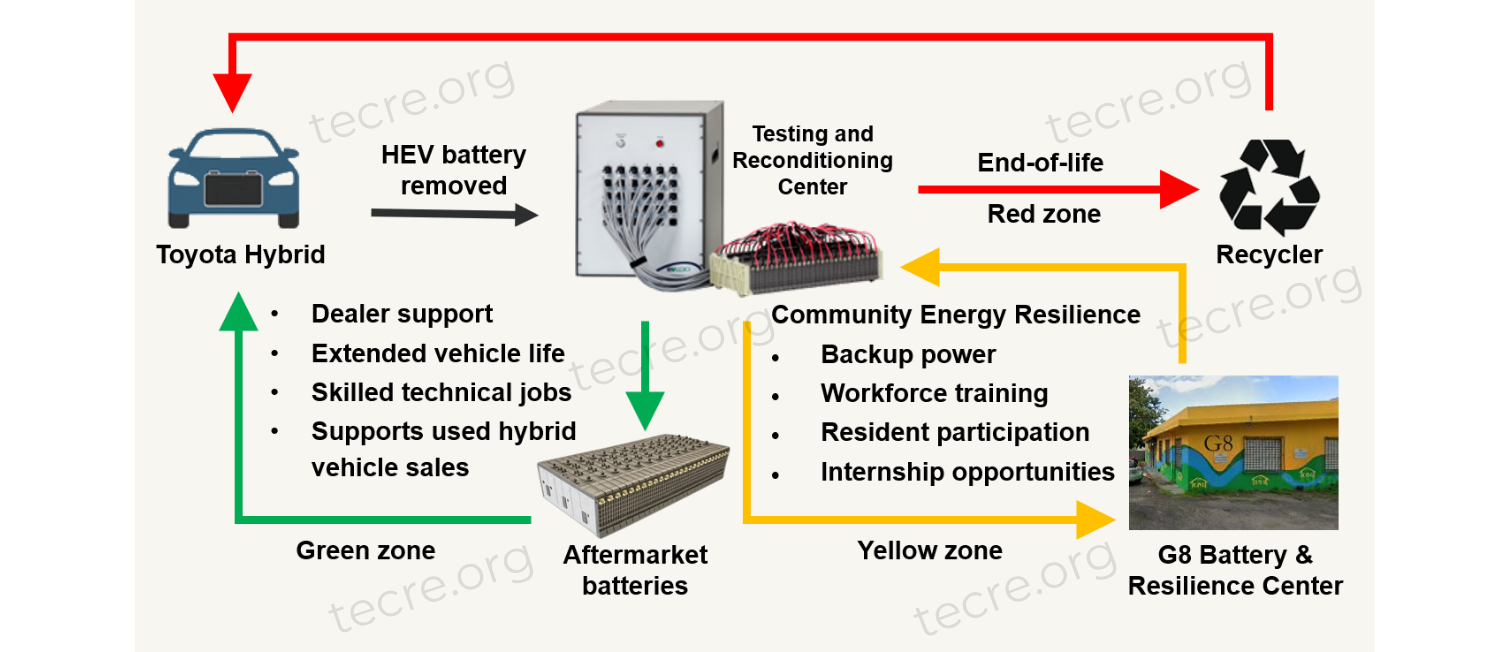
The successful establishment of the Green Zone™ and Yellow Zone™ will create the operational foundation of Puerto Rico’s first self-sustaining Circular Battery Economy™. The Green Zone™ will operate as a battery reconditioning and vehicle installation center that restores hybrid vehicle battery modules for automotive reuse. Working alongside the Green Zone™, the Yellow Zone™ will repurpose battery modules that no longer meet automotive performance requirements. Battery modules that no longer meet automotive performance requirements will be incorporated into residential energy storage systems. These systems will provide nearly no cost backup power for residents affected by frequent electrical outages, creating additional value before batteries ultimately enter the Red Zone™ for responsible material recovery.
The G8 communities of the Caño Martín Peña will serve as the home of the enterprise. Core technical and operational positions will be filled by residents, creating stable employment while developing specialized expertise within the community. Students from universities and partner institutions will work alongside experienced technicians through internships and cooperative education programs, gaining practical experience in battery diagnostics, renewable energy systems, remanufacturing, entrepreneurship, and community engagement.
The result will be more than a battery program—it will be a collaborative ecosystem connecting communities, universities, industry, and government around a shared mission of energy resilience and sustainable economic development. The knowledge, workforce, and business infrastructure established during this phase will provide the foundation for expanding the Circular Battery Economy™ throughout Puerto Rico. Success will not be measured solely by the number of batteries reconditioned or energy storage systems installed. Instead, success will be measured by the creation of a permanent workforce, sustainable community enterprises, and a practical model that can be replicated throughout Puerto Rico and adapted by island and coastal communities around the world.
