Where Innovation Meets Community
Turning innovation into real world solution for a more resiliant Puerto Rico
Puerto Rico is uniquely positioned to demonstrate how retired hybrid and electric vehicle batteries become valuable community assets. The island combines abundant solar resources, growing energy resilience needs, an expanding fleet of electrified vehicles, and strong partnerships among industry, universities, government, and local communities.
A Circular Battery Economy (CBE) is critical to any location with abundant solar resources, growing energy resilience needs, and/or an expanding fleet of hybrid and electric vehicles. A CBE is designed to maximize the value of battery materials through reuse, repurposing, and responsible end-of-life management. By extending battery lifetimes, developing workforce skills, supporting community energy projects, and creating pathways for future recycling and material recovery, a CBE presents a model for sustainable battery stewardship.
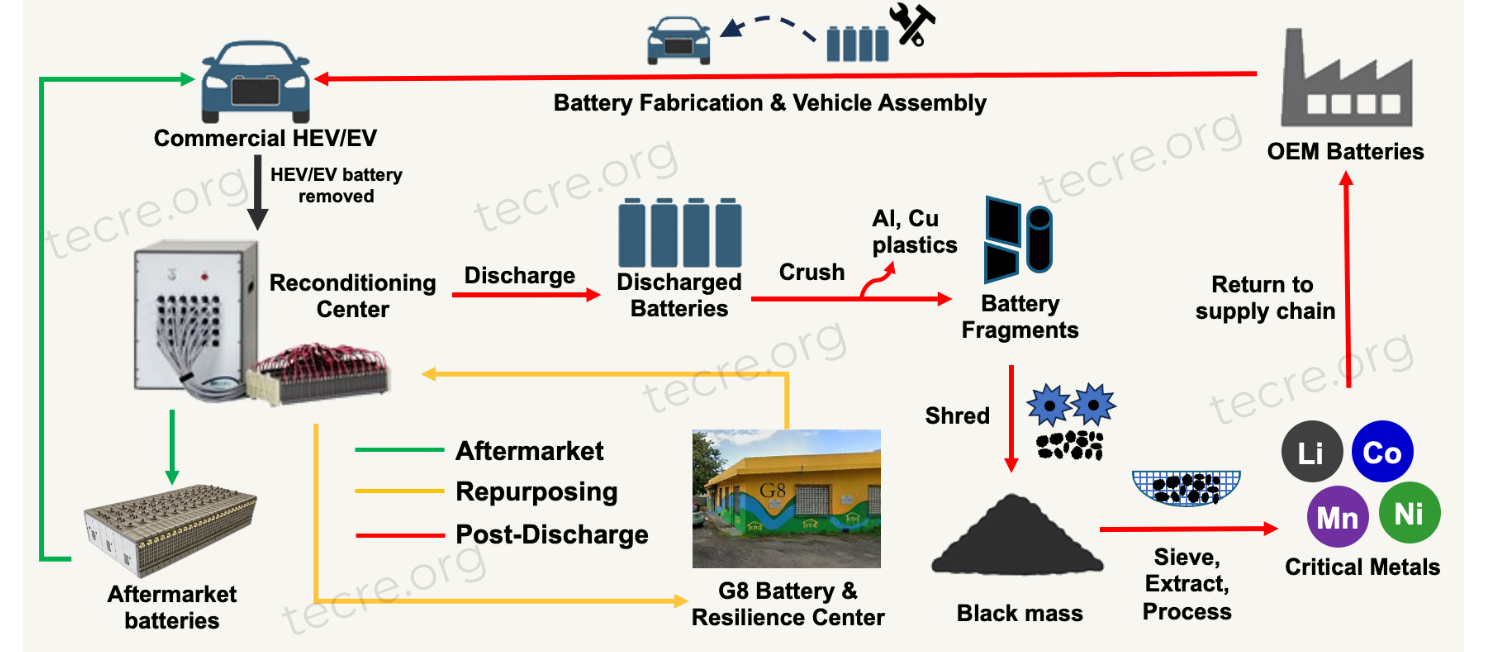
Figure: The Circular Battery Economy
The figure illustrates a CBE for hybrid and electric vehicle (EV) batteries. As hybrid vehicle batteries age, they gradually lose performance and are eventually removed from service. The individual battery modules can often be reconditioned through controlled charge-discharge cycling. Modules that meet automotive performance requirements can be reused in reconditioned aftermarket battery packs at a cost substantially lower than that of a new battery (green zone). Modules that no longer meet automotive requirements but still retain significant energy storage capability can be repurposed for lower-power applications, such as community energy storage systems (yellow zone). Only after their useful life has been fully utilized are modules directed toward recovery and recycling (blue zone), maximizing both economic and environmental value. Through recycling, valuable materials can be recovered and metal ion salts can be returned to battery manufacturing supply chains, thus closing the loop.
TECRE is working to help build Puerto Rico's circular battery economy, a system designed to maximize the value of battery materials through reuse, repurposing, and responsible end-of-life management. By extending battery lifetimes, developing workforce skills, supporting community energy projects, and creating pathways for future recycling and material recovery, Puerto Rico can become a model for sustainable battery stewardship.
The Circular Battery Economy Model schematizes a circular battery economy where batteries are first evaluated for continued automotive service (green zone). Those that do not meet vehicle requirements can be repurposed for lower-power applications such as community energy storage (yellow zone). Only after their useful life has been fully utilized are materials directed toward recovery and recycling (blue zone), maximizing both economic and environmental value.
This vision is not merely theoretical. As documented in Northeastern University's Powering Puerto Rico documentary, TECRE successfully reconfigured retired Toyota hybrid battery modules into a solar-powered residential energy storage system that provided backup power for a family in Utuado, Puerto Rico. This demonstration is proof of concept on how retired vehicle batteries can become community assets that will contribute to Puerto Rico's circular battery economy.
TECRE envisions a future where retired batteries are no longer viewed as waste, but as valuable resources that support community resilience, innovation and workforce development. Through collaboration among researchers, industry partners, and local communities, TECRE aims to help establish a model for circular battery stewardship that can be replicated beyond Puerto Rico.